
The Earlier We Start, the More We Can Help
Children's eyes grow fastest between ages 6 and 14.
Starting treatment early can make a much bigger difference than waiting.
1 in 2
children worldwide may have myopia by 2050
5x
higher risk of serious eye disease with high myopia
67%
slower eye growth with stellest lenses in studies
4
proven treatments available right here in our office
Understanding Myopia
What Is Myopia — and
Why Should You Care?
Myopia means nearsighted — your child can see things up close, but far-away things look blurry. It happens when the eye grows a little too long, so light lands in the wrong spot inside the eye.
Think of it like a football instead of a basketball — the eye is stretched just a little too much. That stretch causes the blurry vision, and it usually gets worse each year as kids grow.
Here's the important part: stronger glasses fix blurry vision, but they don't stop the eye from growing. The longer the eye gets, the higher the risk of serious eye problems as an adult — like a detached retina,
glaucoma, or early cataracts.
The great news: we can slow that growth — and the sooner we start, the better the results.
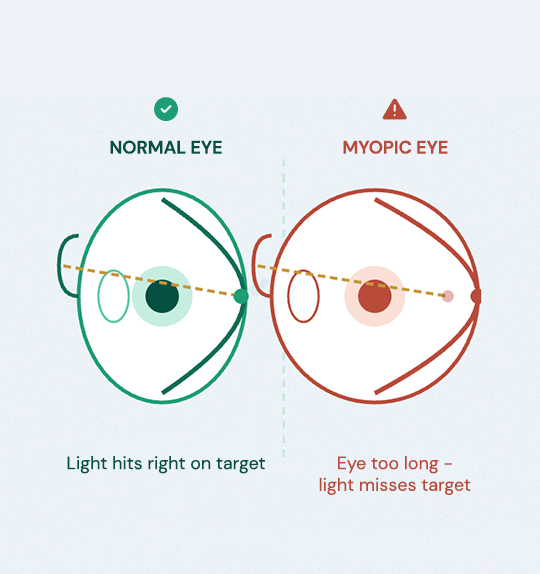
When the eye grows too long, the blur gets worse each year.
Warning Signs to Watch For
Is Your Child Showing These Signs?
You don't have to wait for things to get worse. These are signs it's time to bring your child in for a myopia evaluation.
Stronger glasses every single year
If your child's prescription keeps going up year after year, their eye is still growing too fast. That's not just a glasses issue — it's a health issue we can help slow down.
Squinting to see far away
Squinting at the board at school, the TV from across the room, or road signs outside — these are signs their distance vision is getting worse and needs attention.
Mom or Dad wears glasses
Myopia runs in families. If one or both parents are nearsighted, your child is much more likely to develop it too — and to progress faster. Early screening matters even more for these kids.
Lots of screen time, little outdoor time
Children who spend most of their time indoors on screens and less than 1–2 hours a day outside are at a higher risk. Natural outdoor light actually helps protect young eyes.
Struggling to see at school
Can't see the board? Getting headaches after reading? Myopia can make school harder in ways that aren't always obvious. Many kids don't even realize their vision isn't normal.
Glasses started before age 10
The younger a child is when they first need glasses, the more years their eyes have to keep growing — and the worse it can get. Starting treatment young protects their future vision.
Learn More
Why Does It Matter So Much?
Parents often ask: "Why can't we just get stronger glasses?"
Tap each topic to understand the real answer — in plain, simple terms.

Stronger glasses fix blurry vision — but they don't stop the eye from growing
Think of it this way: giving a child stronger glasses is like turning up the volume on a TV with a broken speaker. It works for now, but it doesn't fix the real problem. Every time the prescription goes up, the eye has grown a little longer. That growing is what causes bigger problems later in life. Myopia management treatments actually slow the eye from getting longer — that's the difference between just seeing clearly today and protecting your child's vision for life.

A longer eye means higher risk of serious eye problems later in life
When the eye grows too long over many years (called "high myopia"), the tissue inside gets stretched thin — like a balloon that's been blown up too much. This raises the risk of a retinal detachment, where the back of the eye peels away like wallpaper — a serious emergency. It also raises the chances of glaucoma, early cataracts, and macular degeneration. These aren't just scary statistics — they're real risks backed by decades of research. The goal is to keep your child's prescription as low as possible, so those risks stay small.

Eyes grow fastest between ages 6 and 14 — that's the window to act
During the school years, children's eyes are growing right along with the rest of their body. This is exactly when myopia can get worse very quickly. A child who starts wearing glasses at age 7 can end up with a prescription 4–6 times stronger than a child who first needs glasses at 14 — simply because their eyes had more years to keep growing. Starting treatment during this window gives us the best chance to limit how strong the prescription gets. Every year we wait is a year of growth we can't take back.

Time outside in natural light actually helps protect young eyes
Studies show that children who spend at least 1–2 hours outdoors each day in natural light are less likely to develop myopia — and if they do, it tends to progress more slowly. The bright outdoor light sends a signal to the eye to grow at a healthy pace. It's not about sports or exercise specifically — it's the light itself that helps. That said, outdoor time alone usually isn't enough once myopia has already started — that's where our treatments come in. Think of outdoor time as a helpful teammate, not a substitute for care.
Interactive Tool
How Much Is My Child at Risk?
Adjust the sliders below to get a general idea of your child's risk level.
This is just for learning — only a real eye exam with Dr. Patel gives us the full picture.
All Options Available Here
Every Proven Treatment — One Office, One Team
Dr. Patel will recommend the best option — or combination — based on your child's age,
lifestyle, and prescription. You'll never need to go somewhere else.
TAP ANY CARD TO LEARN MORE
Ortho-K
Special lenses worn only at night
Ortho-K lenses are worn while your child sleeps. By morning, they gently reshape the front of the eye so your child sees clearly all day — no glasses, no contacts. Research shows they can slow eye growth by up to 77%. Perfect for kids in sports or kids who don't want to wear glasses to school.
Ages 6+
No daytime lenses needed
MiSight® 1 Day
FDA-approved daily soft contacts
MiSight 1 day is the only FDA-approved contact lens made specifically to slow myopia in children. They're soft daily lenses — throw them out each night and put in a fresh pair each morning. Clinical studies showed 59% slower myopia progression over 6 years. Safe, easy, and comfortable for kids.
FDA Approved
Ages 8–12+
Stellest™ Lenses
Myopia-slowing glasses — looks totally normal
Stellest lenses look just like regular glasses but have a special design built in that signals the eye to slow its growth. Studies showed an average 67% slowing of myopia progression. A great option for younger children who aren't ready for contacts — they just wear them all day like any other glasses.
Looks like regular glasses
No contacts needed
Atropine Eye Drops
Tiny nightly drops, meaningful results
Low-dose atropine drops are placed in the eyes once each night before bed. They've been studied for decades and are well-known to slow eye growth significantly. The dose we use is very small (0.01%–0.05%) — safe and well-tolerated. Often combined with glasses or contact lens treatments for even better results.
Once nightly
Can be combined with other treatments
Precision Technology
We Measure Everything — Right Here in Our Office
Tracking myopia isn't just about updating a prescription. We measure the actual length of your child's eye so we always know if the treatment is working. No referrals, no trips to a specialist. All under one roof.
A-Scan — Eye Length
Measurement

We measure exactly how long your child's eye is — in millimeters — at every visit. Even a tiny bit of extra growth matters. Most offices don't measure this. We do, because it's the most important number in myopia management.
✔ Right Here In Our Office
Corneal
Topography

A detailed map of the front surface of your child's eye. Quick, painless, no drops needed. We use it to fit Ortho-K lenses perfectly and to monitor corneal health over time — like a GPS for the eye.
✔ Right Here In Our Office
Comprehensive
Eye Exam

Every myopia patient starts with a thorough exam — not just a quick vision check. Dr. Patel looks at the inside of the eye, the retina, eye pressure, and the full prescription. We get the complete picture before making any plan.
✔ Right Here In Our Office
Structured
Follow-Up Visits

We schedule follow-up visits every 3–6 months to re-measure your child's eye length and prescription. You'll always know how they're doing and whether the treatment is working. If we need to adjust, we act quickly.
✔ Right Here In Our Office
Parent Questions Answered
We Hear These Questions All the Time
My child already wears glasses — isn't that enough?
Glasses help your child see clearly right now, which is important — but they don't stop the eye from growing. Every time the prescription gets stronger, the eye has stretched a little more. Over many years, that adds up to real health risks as an adult. Myopia management is about slowing that stretching so your child ends up with the lowest possible prescription and the healthiest possible eyes long term.
When should we start? My child is only 7.
As soon as possible — and yes, age 7 is a great time to start! Eyes grow fastest between ages 6 and 14, so starting treatment early means we can prevent more growth than if we wait. A child who starts at age 7 has far more to gain than one who waits until 12. If your child is already wearing glasses, now is the right time to ask about management options.
Are contacts safe for my young child?
Yes — when fitted properly and used under a doctor's supervision. MiSight lenses are approved for children as young as 8, and Ortho-K can be used starting around age 6. Daily lenses like MiSight are actually very hygienic because you throw them out every night — there's nothing to clean or store. We take time to make sure your child is fully comfortable and confident before sending them home with lenses.
Does insurance cover myopia management?
It depends on the plan. Some vision plans (VSP, EyeMed, Davis Vision, CareFirst) cover portions of the exam or contact lens fitting. We'll review your benefits before you start and explain clearly what's covered and what's not — no surprises. Many families also use FSA or HSA funds for myopia management costs. We'll work with you to make the best plan for your budget.
How will we know if the treatment is working?
That's exactly what our A-Scan is for. At every follow-up visit, we re-measure the actual length of your child's eye. If the eye has stopped growing — or is growing much more slowly than before — the treatment is working. We show you the numbers and explain them in plain language at every visit. You'll never be left guessing about how your child is doing.
Do we need to go to different offices for all of this?
Nope — and that's one of the things that makes Eye See Optical special for myopia care. We offer all four proven treatments AND all the measurement tools you need — A-Scan, topography, comprehensive exams, and structured follow-ups — all right here in our Kensington office. One doctor who knows your child. One team you can trust. No referrals needed.

Contact Us
Let’s keep in touch!

Office Hours
- Monday 10:00am - 6:00pm
- Tuesday 10:00am - 6:00pm
- Wednesday 10:00am - 6:00pm
- Thursday 10:00am - 6:00pm
- Friday 10:00am - 6:00pm
- Saturday Closed
- Sunday Closed
If you dont cancel within 24 hours of your appointment there will be a $50 charge
© 2026 Eye See Optical | All rights Reserved | Accessibility Statement | Privacy Policy | Sitemap
Powered by:
